
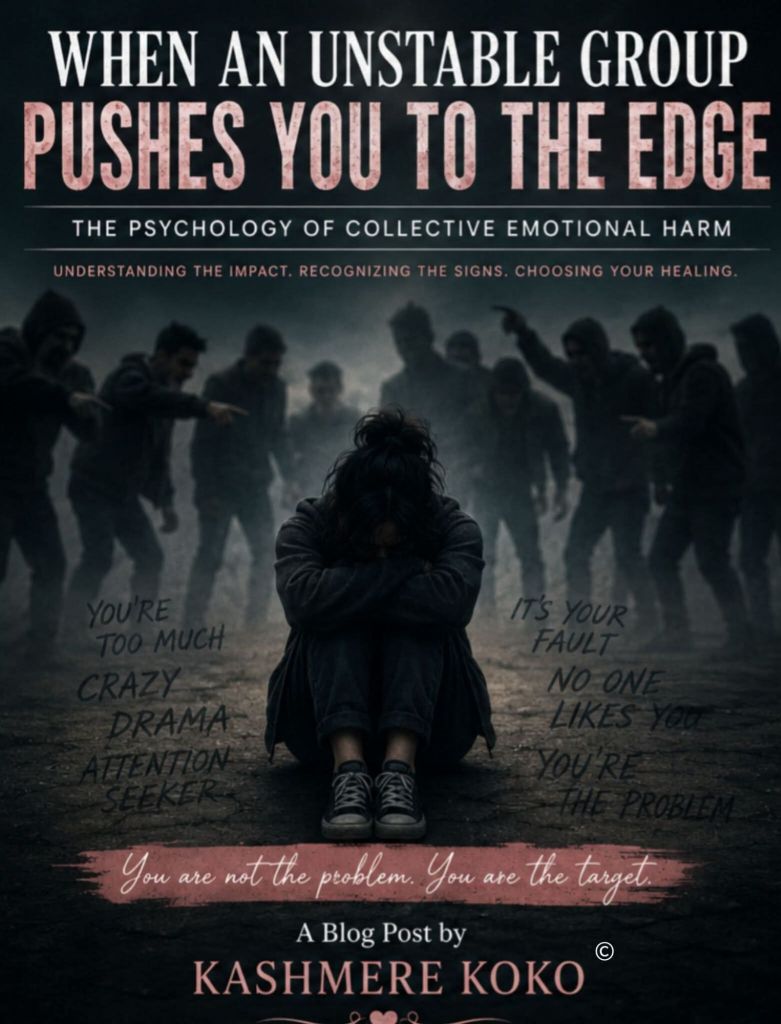
There is a dangerous psychological phenomenon that does not get discussed enough: what happens when a group of emotionally unstable people collectively push one person beyond their mental limits.
Sometimes it happens in families. Sometimes in workplaces, friend circles, online communities, schools, religious groups, or relationships. One person slowly becomes the emotional dumping ground for the chaos, insecurity, fear, resentment, or instability of the entire group.
At first, it may look like “drama,” conflict, teasing, or tension.
But over time, the pressure becomes psychological warfare.
The targeted person begins to feel emotionally cornered, mentally exhausted, isolated, confused, and emotionally unsafe. In severe situations, the stress becomes so overwhelming that thoughts of self-harm begin to appear — not because the person is weak, but because the human nervous system can only withstand so much sustained emotional pressure before it begins to break down.
The Hidden Danger of Group Instability
An unstable group behaves differently from an unstable individual.
One emotionally reactive person can cause harm. But when several emotionally reactive people begin feeding off each other’s behavior, the situation can intensify rapidly.
Fear spreads. Paranoia spreads. Anger spreads. Cruelty spreads. Justification spreads.
People begin validating each other’s worst impulses instead of challenging them.
This is why group dynamics can become psychologically dangerous. Individuals who might never act aggressively alone may participate in emotional attacks when surrounded by others doing the same thing.
Psychologists and sociologists have studied this for decades through concepts like:
Groupthink — where people suppress reason to maintain group unity.
Mob mentality where emotional intensity overrides empathy and accountability.
Scapegoating where one person becomes the target for the group’s pain, frustration, or instability.
Gaslighting where the victim’s reality is repeatedly denied or distorted.
Mobbing coordinated bullying or psychological targeting by multiple people.
Coercive control using fear, shame, intimidation, or emotional pressure to dominate someone psychologically.
When these behaviors combine, the emotional environment becomes toxic and destabilizing.
How Someone Gets Pushed to the Breaking Point
Psychological harm rarely happens all at once.
Usually, it happens in layers.
The person may first notice:
Constant criticism
Mockery disguised as jokes
Being blamed for everything
Emotional exclusion
Manipulation
Rumors or humiliation
Having their emotions dismissed
Being told they are “crazy,” “too sensitive,” or “the problem”
Over time, the nervous system enters survival mode.
The body begins reacting as if danger is always present.
Sleep becomes difficult. Anxiety increases. The person becomes hypervigilant. They begin second-guessing themselves constantly.
Eventually, emotional exhaustion turns into hopelessness.
This is often the stage where thoughts of self-harm emerge.
Not necessarily because the person truly wants to die — but because they desperately want the psychological pain to stop.
That distinction matters.
Why Unstable Groups Often Escalate Instead of Stopping
Healthy groups recognize when someone is emotionally overwhelmed.
Unstable groups often do the opposite.
Instead of pausing, reflecting, or showing compassion, the group may:
Intensify the pressure
Rationalize their behavior
Mock emotional reactions
Treat vulnerability as weakness
Rewrite events to avoid accountability
Encourage others to join in
In highly dysfunctional dynamics, the group begins protecting itself emotionally at the expense of the targeted person.
This creates a dangerous cycle:
The target reacts emotionally from stress.
The group uses the reaction as “proof” the target is unstable.
The pressure increases.
The target deteriorates further.
The group then points to the damage they helped create as justification for continuing the abuse.
The Psychological Effects of Sustained Group Pressure
Long-term exposure to emotionally aggressive group dynamics can cause serious mental and physical consequences, including:
Anxiety disorders
Depression
Panic attacks
Emotional numbness
Dissociation
Insomnia
Loss of self-esteem
Social withdrawal
Complex trauma symptoms
Self-harm thoughts
People often underestimate emotional abuse because there are no visible bruises.
But the nervous system does not distinguish physical danger from sustained psychological danger as cleanly as people think.
The body keeps score.
The Most Important Truth: Leaving Is Not Weakness
One of the biggest lies emotionally destructive groups tell people is: “If you leave, you’re weak.”
In reality, recognizing psychological harm and creating distance from it can be an act of survival.
No one is required to remain inside a mentally unsafe environment to prove loyalty, strength, toughness, or love.
Sometimes healing begins the moment a person stops trying to convince unstable people to become emotionally safe.
Not every battle can be solved through explanation. Not every group wants peace. Not every emotionally chaotic environment can be fixed from within.
Sometimes the healthiest decision is distance.
What Someone Should Do If They Are Being Pushed Too Far
If someone recognizes themselves in this situation, a few things become extremely important:
1. Reconnect With Stable People
Isolation makes emotional harm worse. Safe, grounded people help restore perspective.
2. Document Reality
Gaslighting becomes less powerful when someone keeps records, journals, or written timelines of events.
3. Protect Mental Space
Constant exposure to emotionally unstable dynamics keeps the nervous system activated. Boundaries matter.
Final Thoughts
Emotionally unstable groups can become psychologically destructive without fully understanding the damage they are causing. But intent does not erase impact.
When a person is constantly overwhelmed, emotionally cornered, psychologically manipulated, or treated as the emotional target for a group’s instability, the effects can become devastating.
Mental breakdowns do not always come from a single traumatic moment.
Sometimes they come from hundreds of smaller moments of pressure, invalidation, chaos, humiliation, and emotional exhaustion accumulating over time.
No one deserves to be pushed to the point where self-harm feels like an escape from emotional pain.
And no group has the right to destroy someone’s mental stability in the name of control, entertainment, dominance, or emotional dysfunction.
 Kashmere Koko
You must be logged in to post a comment.